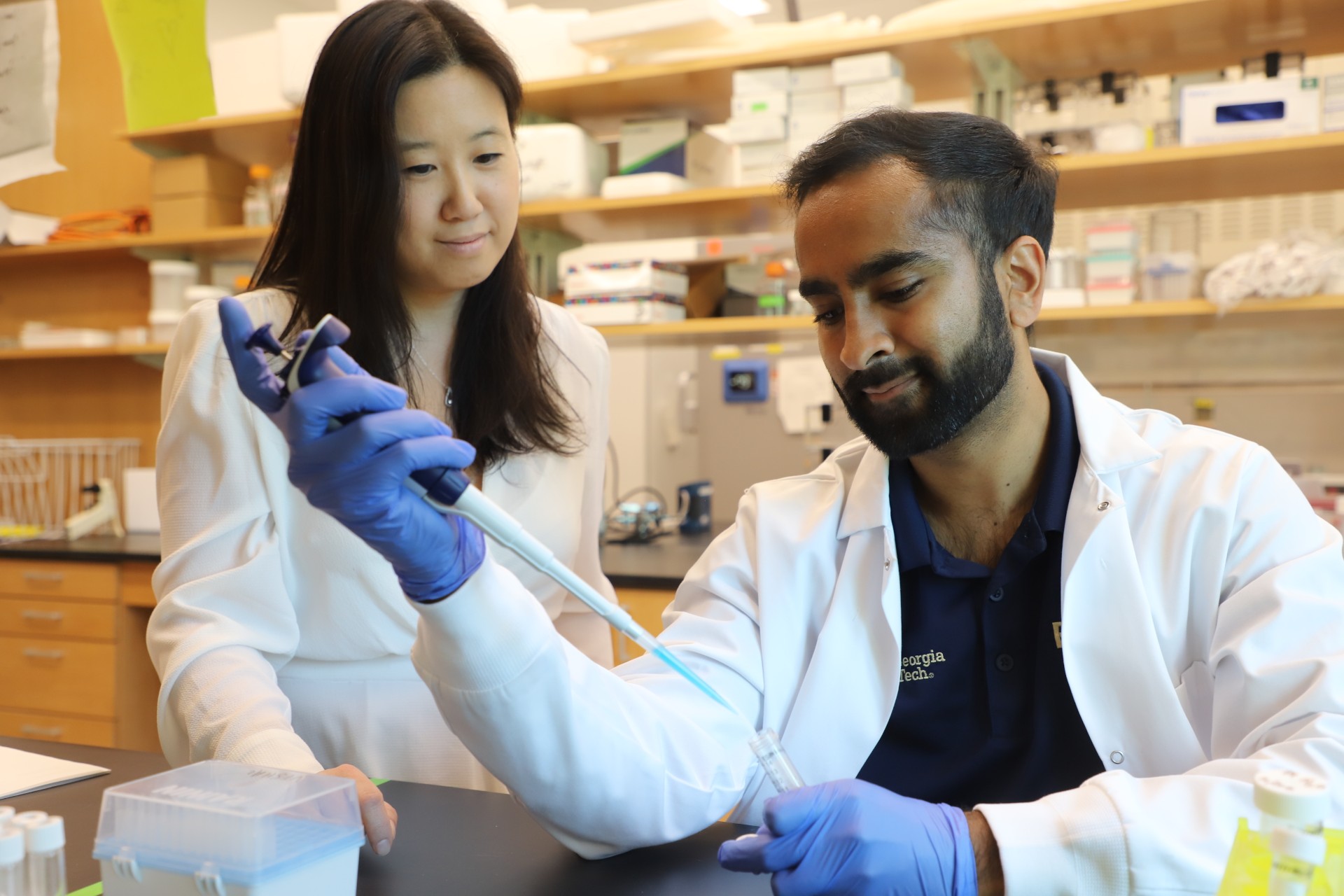
Most people know the gut microbiome as an invisible vast community of microbes quietly carrying out essential work deep inside the body. For Leslie Chan, assistant professor in the Wallace H. Coulter Department of Biomedical Engineering, understanding what those microbes are actually doing, rather than simply identifying which microbes are present unlocks the potential to transform how physicians diagnose disease, personalize treatments, and reduce the side effects of life-saving therapies.
That mission recently led Chan and her research team to develop a novel class of ingestible probes that can measure microbiome activity through a simple breath test. The technology, described in a new study in Science Advances, uses probes made from a sugar molecule linked to a gaseous reporter molecule. After probes are swallowed and reach the large intestine, enzymes produced by gut microbes break them apart, releasing the gaseous reporter molecules that appear in the breath for measurement. The result is a noninvasive way to monitor specific microbial activities occurring deep within the gastrointestinal tract.
"We have these sequencing tools for microbial genes, but we don't have something to measure the activity of microbial gene products once they are produced and undergo activity-regulating modifications," Chan explained. "That's the gap that we're trying to fill right now."
The distinction is important. Current microbiome studies largely rely on genetic sequencing, which reveals what microbial genes are present. But sequencing alone cannot reveal whether those genes are active or what biological functions they are performing. Chan's probes focus on measuring enzyme activity, providing a functional snapshot of the microbiome in real time.
Her research centers on a microbial enzyme called β-glucuronidase, or GUS, which is known to reactivate certain drugs after they have been deactivated and detoxified by the liver. One notable example is irinotecan, a chemotherapy used to treat cancer. Once the deactivated drug reaches the intestine, GUS can reactivate it, causing damage to the gastrointestinal lining and contributing to severe side effects, forcing physicians to reduce drug dosing or stop treatment altogether. Researchers have long viewed GUS as an attractive drug target, but measuring its activity inside the body has remained challenging.
"Someone with very high GUS levels, they're probably going to have higher GI toxicity from this drug compared to someone with lower levels," Chan said. "We can assess their GUS levels to see how much they are at risk for GI toxicity and decide whether or not there is a need to inhibit those activities with new GUS inhibitor drugs."
For Chan and her graduate students, the fascination with gastrointestinal disease is also personal. She has lost close family friends to gastrointestinal cancers, and several of her graduate students joined her lab due to their own experiences with digestive diseases. During the COVID-19 pandemic, she experienced significant digestive issues herself, sparking a deeper curiosity about the complex relationship between human health and the gut microbiome.
What makes the new probe platform especially exciting is its flexibility. Chan describes the technology as molecular "Legos." By swapping different sugar molecules and gaseous reporters, her team can design probes that detect a wide range of enzyme activities associated with different diseases.
"This is just the tip of the iceberg," Chan said. "Now that we have a better understanding of how to design these probes, we can start creating a wide array of probes to detect other GI diseases."