Title

MBID, MBID-AT Graduates Inspired to Solve Healthcare's Toughest Challenges

Subhead
Graduates of the MBID and inaugural MBID-AT programs leave prepared to tackle healthcare challenges through innovation, collaboration and leadership.
ID
Aug 04, 2026 | By Kelly Petty
News Image
Graduates of the MBID program in Coulter BME are standing on the steps of the Historic Academy of Medicine with their caps and gowns on tossing their caps in the air. The department chair, two faculty, and the program director or standing on the right side of the steps.
Image Caption
2026 graduates of the Master's in Biomedical Innovation and Development program at the Historic Academy of Medicine.
Widgets

Students from the Master of Biomedical Innovation and Development (MBID) and Master of Biomedical Innovation and Development in Advanced Therapeutics (MBID-AT) programs crossed the stage on July 30 at graduation ceremonies held at the Historic Academy of Medicine and Emory HSRB II Auditorium.

The Department hosted the small commencement ceremonies to honor students who spent the past year learning how to transform unmet clinical needs into real-world healthcare solutions. Through interdisciplinary coursework, clinical immersion experiences, and team-based innovation projects, graduates developed technologies and strategies aimed at improving patient care, advancing therapeutics, and addressing some of healthcare's most pressing challenges. 

The day carried added significance for the MBID-AT program, which celebrated the graduation of its inaugural cohort. The first eight students in the program helped launch a new educational model focused on advanced therapeutics, cell and gene therapies, and regenerative medicine.

Reflecting on their role in shaping the program, MBID-AT Program Director Carolyn Yeago described the graduates as "the fearless eight who started off this inaugural program and have really laid the foundation for an amazing future for themselves and an amazing future for this program." 

Throughout both ceremonies, speakers returned to a common theme: meaningful innovation requires courage, curiosity, and a willingness to take risks.

Addressing the MBID-AT graduates, Department Chair Alyssa Panitch praised the students for embracing both a new degree program and a rapidly evolving field.

"I think all of you are also entrepreneurs and risk-takers at heart, given that you are our first students in this new program," Panitch said. "Not only did you take a chance on the new degree that's unmatched anywhere else in the country, but you chose a relatively new and burgeoning area: advanced therapeutics, gene and cell therapies, and regenerative medicine are some of the fastest moving fields in modern medicine." 

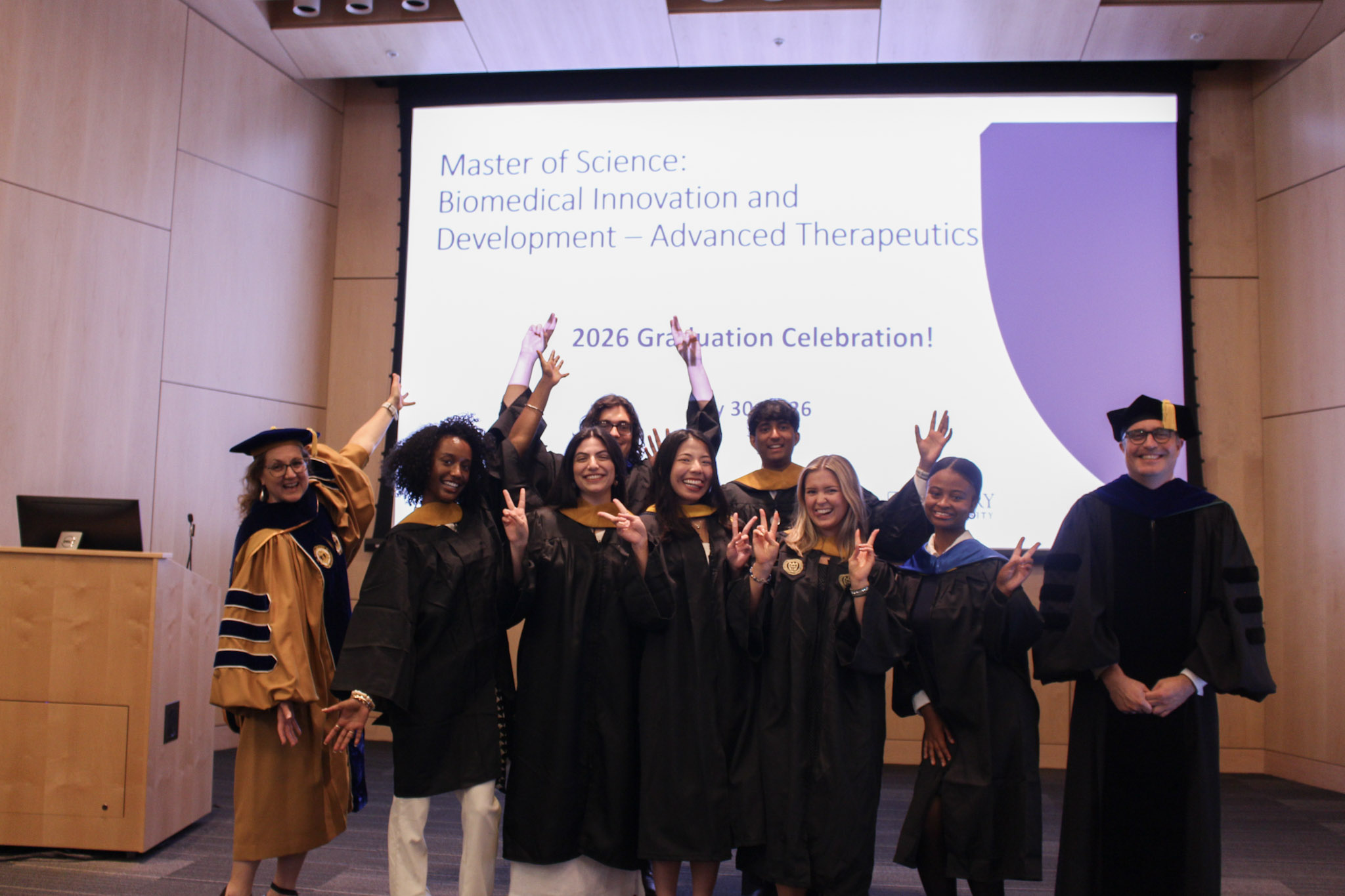
Graduates of the MBID-AT program inside of the auditorium at Emory University posing in their caps and gowns with their program director.
The inaugural class of the Master's in Biomedical Innovation and Development - Advanced Therapeutics celebrate graduation at Emory University.

At the MBID ceremony, graduates showcased projects developed through months of clinical observations and collaboration with physicians. Teams tackled challenges ranging from ICU delirium prediction and benign prostatic hyperplasia procedures to esophageal stricture treatment and patient monitoring technologies. 

Michael Fisher, director of the MBID program, reminded attendees that the curriculum extends far beyond technical knowledge. Through time spent in hospitals and clinics, students learn to understand the realities of patient care and the complexity of bringing medical technologies to market.

"We're trying to improve the human condition," Fisher said. "So, we teach them how do you look for unmet clinical needs? Where are things not working?" 

For MBID-AT students, that same philosophy was applied to advanced therapeutics. During the ceremony, teams presented projects focused on developing commercialization, regulatory, and clinical strategies for innovative treatments targeting atherosclerosis in cancer survivors and glioblastoma. Their work required students to think beyond the science itself and consider pathways for manufacturing, reimbursement, regulatory approval, and patient access.

Yeago highlighted that broader perspective, noting that successful therapies depend on far more than research breakthroughs alone.

"If we create something that cannot get to patients because we didn't think about what our clinical trial strategy would be, what that label should say, or how the treatment is going to get paid for, we're not doing our patients any service by creating a technology that they can't utilize," she said. 

Several speakers challenged graduates to embrace uncertainty as they begin their careers. Speaking to the MBID-AT cohort, Jeffrey Staton, senior associate dean of the Laney Graduate School, encouraged students to view failure as part of the innovation process.

"Do not ever be afraid to be wrong," Staton said. "You are surely going to be wrong, like a lot. Okay. In fact, I'd advise you to try to be wrong, and useful." 

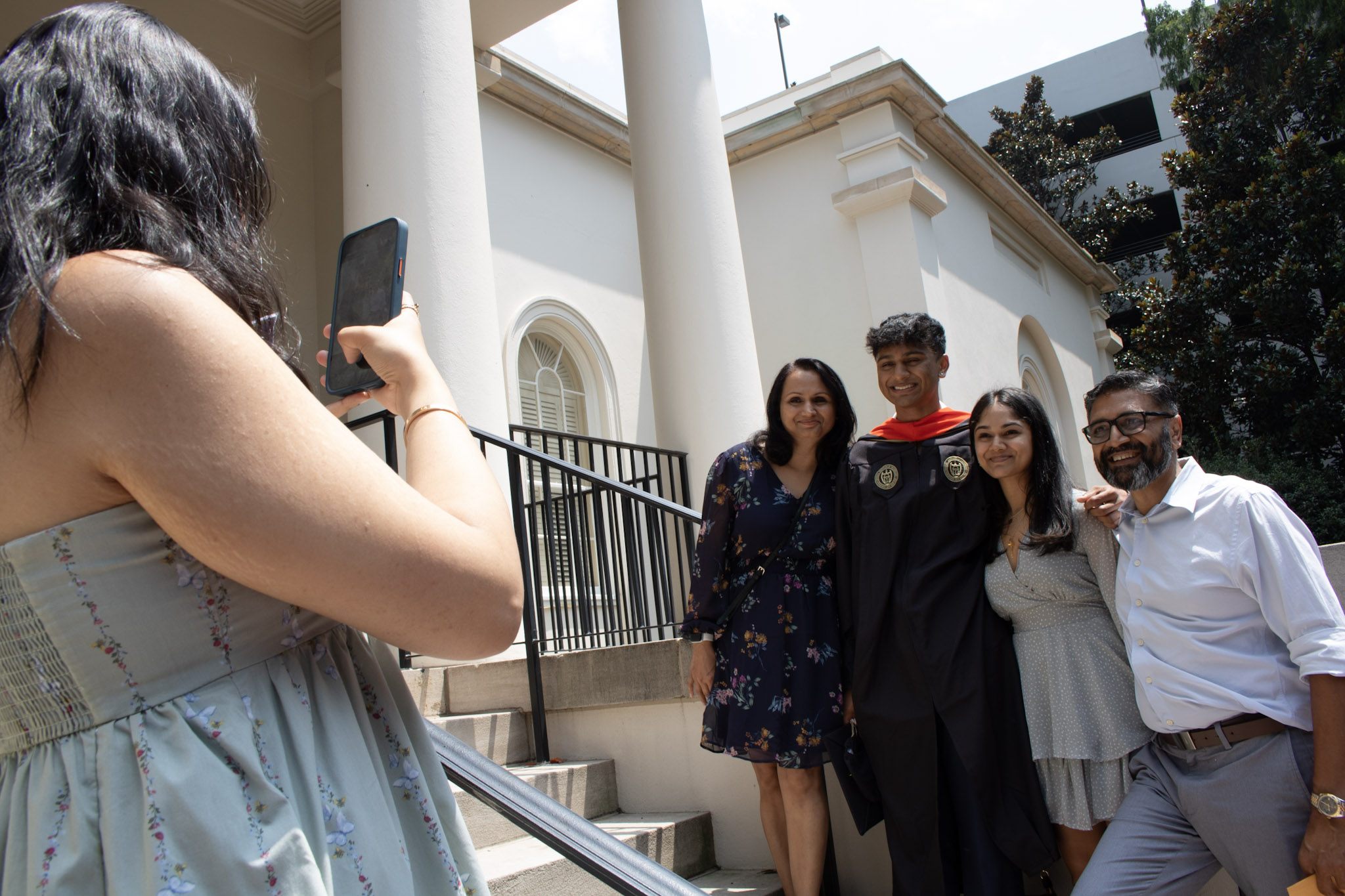
A young woman takes a photo with her cell phone of a male graduate of the MBID program standing with his parents.
Graduates of the MBID program took photos with family and friends celebrating a major milestone in their education.

The graduates' own reflections echoed that spirit.

For Rachel Clark, the MBID-AT experience helped redefine what success in the biomedical industry could look like.

"This program taught me how to bring medicine from the bench to the bedside," Clark said. "I recently accepted a dream job for a position I didn't even know existed before beginning this program." 

MBID-AT graduate Madison McCoy, who entered the program from a clinical laboratory science background, reflected on the value of embracing change and new opportunities.

"My advice to everyone is, don't be afraid to pivot, and be comfortable in that pivot because that's when you learn the most," she said.

The MBID ceremony concluded with a challenge from adjunct faculty member Rafael Andino, who urged graduates to think about the long-term impact of their careers on healthcare and society.

"Don't make it a dress rehearsal. Make it the real thing. Raise your hand and volunteer for the big problems," Andino said. “Move the needle.”

Representing the MBID Class of 2026, student speaker Jayant Kurvari reflected on the shared journey that brought classmates to graduation day.

"Every person in this room has a different story," he said. "Yet, despite all of our different paths, our experience, our responsibilities, we all arrived at the same place today, and that's what makes this moment so special." 

As graduates from both programs were recognized by faculty leaders and crossed the stage to receive congratulations from Prof. Panitch, the day marked more than the end of an academic year. It celebrated the beginning of careers dedicated to solving complex healthcare challenges and improving lives through innovation. 

Closing the MBID ceremony, Panitch reminded graduates that commencement represents both an ending and a beginning.

"As you leave this program, may you continue to approach every challenge with curiosity, every opportunity with courage, and every success with humility," she said. 

For the Class of 2026, and for the inaugural MBID-AT cohort that helped launch a new chapter in biomedical innovation education, that next journey has already begun. 

View the full photo galleries of the MBID-AT and the MBID commencement ceremonies.

Media Contact

Contact the BME Communications team to connect with a faculty member or student about academics or research happening in the Wallace H. Coulter Department of Biomedical Engineering.