Title

Yilin Cai Awarded for Adaptive Soft Robotics Research

Subhead
Ph.D. student earns honors from ASME and IROS for research on modular robotic systems that can adapt to changing tasks and environments.
ID
Oct 22, 2026 | By Leeanna Allen
News Image
Close-up of a modular, snake-like robotic device with exposed wiring, sensors, and claw-like grippers at both ends being held by two people in a laboratory setting. The flexible robotic structure features black and orange components connected by segmented joints.
Image Caption
Yilin Cai (front) and Zhefeng Huang (rear) pose with the modular robotic system
Widgets

Fourth-year Coulter Department of Biomedical Engineering Ph.D. student Yilin Cai earned two honors for research exploring new approaches to adaptable robotic systems.  

Cai received first place in the 2026 American Society of Mechanical Engineers (ASME) Student Mechanism and Robot Design Competition and the Best Poster Award at the Workshop on Mechanical Intelligent Soft Robotics during the 2026 Institute of Electrical and Electronics Engineers (IEEE) and Robotics Society of Japan (RSJ)/International Conference on Intelligent Robots and Systems (IROS) for the project Modular Self-Reconfigurable Continuum Robot for Adaptive Loco-Manipulation. 

The awards recognize the innovative robot design of Cai's research, conducted with faculty advisor Yue Chen. Colleague Zhefeng Huang also contributed to the project by developing algorithms that allow the robotic system to reconfigure itself autonomously. 

“I was honored to receive these awards, which I see as meaningful recognition of our team’s efforts,” Cai said. “I have always been confident in the novelty and potential of our work, but what I found most rewarding was the opportunity to share our ideas with the broader robotics community and see others appreciate the possibilities of this new robotic paradigm.” 

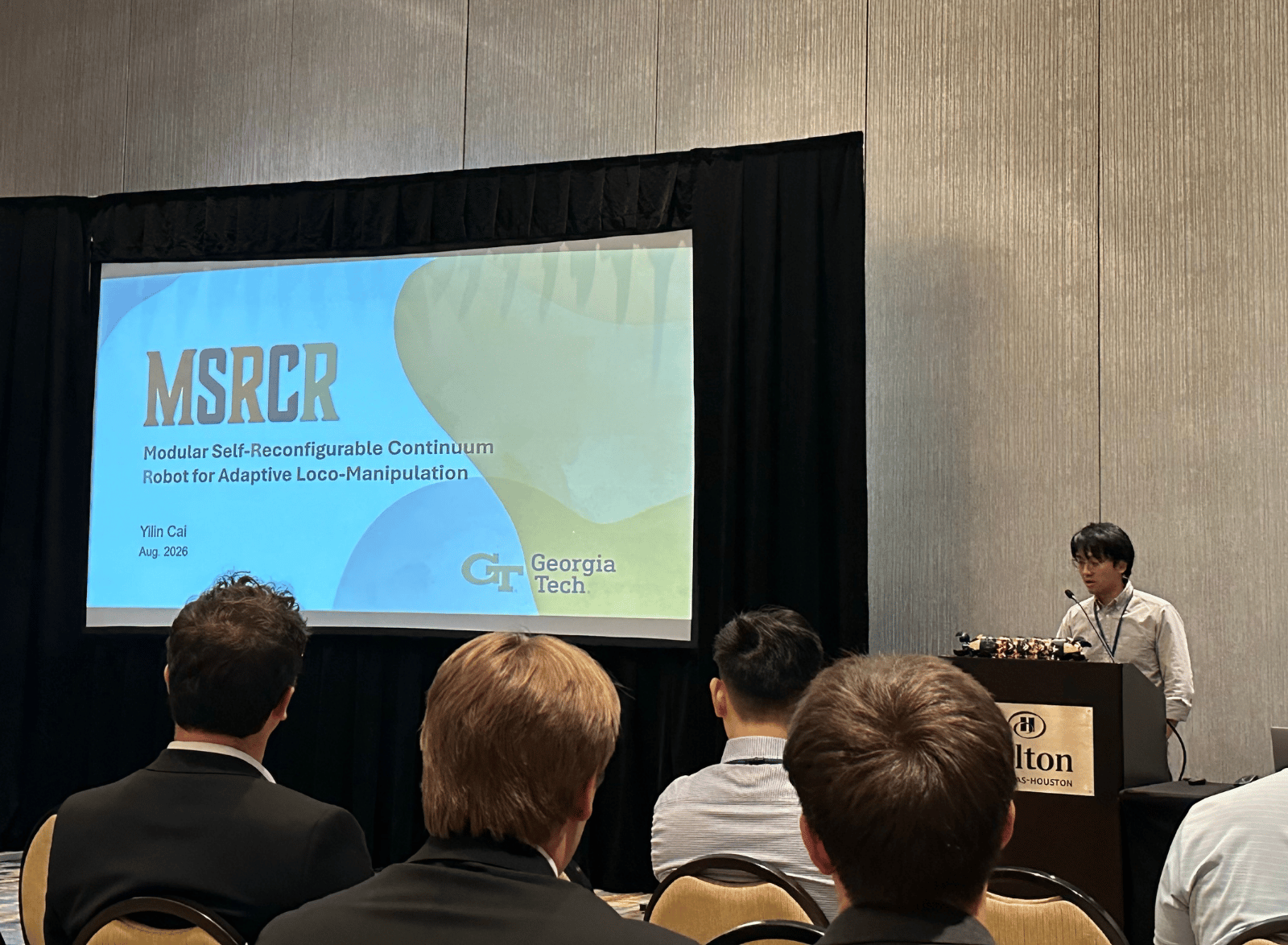
A researcher presents a talk at a conference, standing at a podium beside a projected slide titled “MSRCR: Modular Self-Reconfigurable Continuum Robot for Adaptive Loco-Manipulation.” Audience members are seated facing the screen, and a small prototype robot rests on the podium during the presentation.
Cai presents his research at the 2026 ASME Student Mechanism and Robot Design Competition.

Robotic systems are often designed for specific tasks and operate with fixed body structures. When requirements change, engineers may have to redesign the hardware to perform new functions. 

Cai’s research explores an alternative approach: creating a common set of robotic building blocks that can be assembled and reassembled to meet different needs. Taking inspiration from the diverse forms found in nature, the soft robotic system is built from identical modules and rearranged into different structures and movement patterns to show how robots might adapt to changing tasks and environments. Cai’s work was recently published in Science Advances. 

The research contributes to the growing field of physical intelligence, which examines how a robot’s structure and materials influence its behavior and adaptability. 

“I believe soft, modular, and bio-inspired robotics offer a promising pathway toward physical intelligence, where intelligence emerges not only from computation but also from the robot’s physical design, compliance, and ability to adapt to its environment,” Cai said. 

Looking ahead, the team will study how robotic systems can decide for themselves when and how to reconfigure. By combining adaptable hardware with learning and control algorithms, the researchers aim to better understand how physical adaptability and computational intelligence work together. 

For Cai, these awards encourage him to continue pursuing big questions in robotics. 

“These awards are not only a recognition of what we have achieved,” Cai said, “but also an encouraging sign of what lies ahead.” 

Media Contact

Contact the BME Communications team to connect with a faculty member or student about academics or research happening in the Wallace H. Coulter Department of Biomedical Engineering.