Understanding diseases means knowing not only how cells and molecules function in the body, but where they are located. Spatial omics combines imaging with biological data to map these positions so that researchers can learn how diseases and treatments affect cells within their environment.
Creating these detailed maps is not easy. Instrument and operating costs average $500,000 but can top $1 million for the complex imaging and analysis. Systems rarely work together, and sample preparation takes time, space, and specialized expertise.
Those requirements put the technology out of reach for many labs.
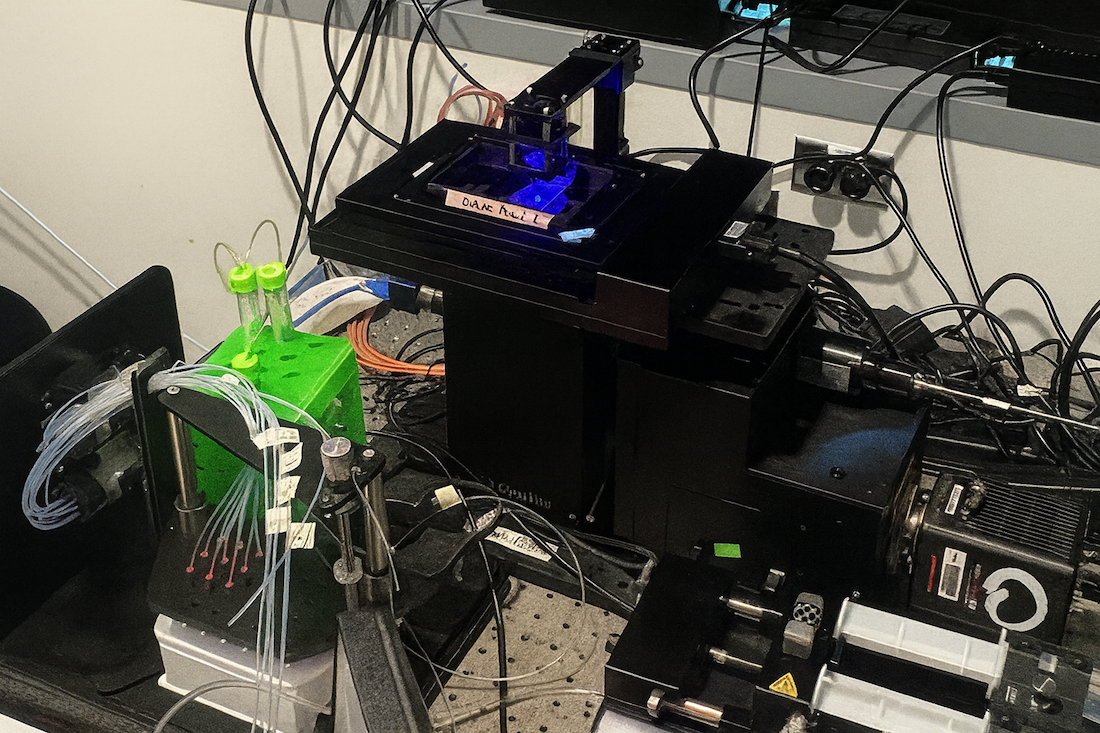
Biomedical engineers at Georgia Tech and Emory University set out to remove these roadblocks to make the technology cheaper, customizable, and easier to access, while still producing high-quality datasets. They created Python-based robotic imaging and staining for modular spatial omics (PRISMS), an open-source, automated process, and recently published in the journal Lab on a Chip.
With PRISMS, labs can map large areas of tissue as well as zoom in on proteins and biomarkers at 10%-20% of the usual cost. The modular nature means researchers can mix and match components and capabilities according to their needs and even add in their own algorithms.
Ahmet Coskun and his team developed PRISMS using a flexible, modular approach, combining off-the-shelf lenses, lasers, and reagents. Ph.D. student Nicholas Zhang created open-source algorithms and training videos to help users navigate the platform. Automated sample preparation workflows cut costs even more. These cost-savings can allow labs to run more samples, analyze larger datasets, and better collaborate with other labs.
"People can bring their questions, samples, and assays and easily adapt them to PRISMS," Coskun, Associate Professor of Biomedical Engineering at the Wallace H. Coulter Department of Biomedical Engineering, said. “It’s a service to the community for us to help bring spatial omics to more people. That’s why we’re passionate about sharing this with other researchers."