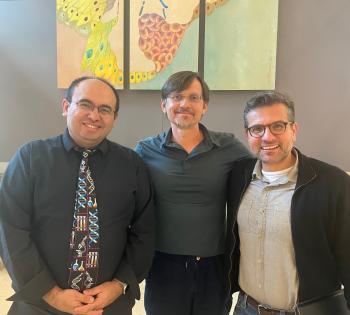
Khalid Salaita
(he/him)
Biography
Khalid Salaita is the Samuel Candler Dobbs Professor of Chemistry, the director of the Center on Probes for Molecular Mechanotechnology, and Director for Graduate Studies in the Chemistry Department at Emory University in Atlanta, Georgia (USA). Khalid grew up in Jordan and moved to the US in 1997 to pursue his undergraduate studies at Old Dominion University in Norfolk, Virginia (USA). He worked under the mentorship of Prof. Nancy Xu studying the spectroscopic properties of plasmonic nanoparticles. He then obtained his Ph.D. with Prof. Chad Mirkin at Northwestern University (Evanston, IL) in 2006. During that time, he studied the electrochemical properties of organic adsorbates patterned onto gold films and developed massively parallel scanning probe lithography approaches. From 2006-2009, Khalid was a postdoctoral scholar with Prof. Jay T. Groves at the University of California at Berkeley (USA) where he investigated the role of receptor clustering in modulating cell signaling. In 2009, Khalid started his own lab at Emory University, where he is currently investigating the use of nucleic acids as molecular force sensors, smart drugs, and synthetic motors. In recognition of his independent work, Khalid has received a number of awards, most notably: the Alfred P. Sloan Research Fellowship, the Camille-Dreyfus Teacher Scholar award, the National Science Foundation Early CAREER award, the Kavli Fellowship, and Merck Future Insight Prize. Khalid’s program has been supported by NSF, NIH, and DARPA.
Education
- Ph.D. in Chemistry, Northwestern University, Evanston, IL
- B.S. in Chemistry, Old Dominion University, Norfolk, VA
Affiliated Centers & Institutes
Research Interests
Cells are highly dynamic, experiencing molecular forces that tune many of their functions. For example, the rapidly fluctuating forces within embryos control development and the forces between T cells and their targets tune immune response. Despite the importance of mechanics in biology there are limited methods to study these forces at the molecular scale. To address this challenge, Dr. Salaita pioneered the development of molecular force probes to visualize and control mechanics in living cells. His work has led to the creation of new force-based tools that include mechano-PCR, mechano-tagging, and mechano-omics technologies that are helping to transform the study of mechanobiology. These probes have revealed the forces involved in a variety of processes spanning from immune recognition and stem cell development to coagulation, and invasion.