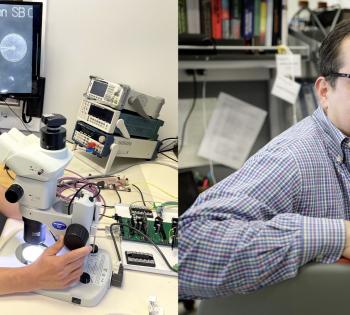
Rafael V. Davalos
(he/him)
Areas of Research
Biomedical Robotics , Cancer Technologies , Cardiovascular Engineering, Immunoengineering , NeuroengineeringContact
U.A. Whitaker Building, 313 Ferst Drive, Suite 2101Georgia TechBiography
Dr. Rafael Davalos' research interests are in microfluidics for personalized medicine, and developing technologies for cancer therapy and treating cardiovascular disease. He is most recognized for co-inventing Irreversible Electroporation (IRE), a minimally invasive non-thermal surgical technique to treat unresectable tumors near critical structures such as major blood vessels and nerves. He also co-invented a second generation version of the technology known as biphasic Pulsed Field Ablation (PFA), which is in use to treat patients with cardiac disease. These technologies have been used to help hundreds of thousands of patients worldwide. Davalos has authored 170 peer-reviewed articles and has 65 issued patents (84 h-index, >24,000 citations) and has secured over $37M in research funding with $10M his share. His patents have been licensed to 7 companies. He has been a plenary speaker for several prestigious venues, including the International Symposium of the Bioelectrochemistry Society, the European Medical and Biological Engineering Conference, the World Congress on Electroporation, and the Society of Cryobiology Annual Meeting. Davalos is a Fellow of the National Academy of Inventors (NAI), the American Society of Mechanical Engineers (ASME), the American Institute for Medical and Biological Engineers (AIMBE), and the Biomedical Engineering Society (BMES).
Education
- Ph.D. Mechanical Engineering (Bioengineering), University of California, Berkeley
- M.S. Mechanical Engineering, University of California, Berkeley
- B.S. Mechanical and Aerospace Engineering, Cornell University
Research Interests
Dr. Rafael Davalos' research interests are at the interface of biotransport, biomedical microdevices, bioelectrics and device design. Dr. Rafael Davalos' research interests are in microfluidics for personalized medicine, biotransport, electroporation, dielectrophoresis, organ-on-chip platforms, and developing technologies for cancer therapy and for treating cardiovascular disease. Active projects in the lab include 3D printing the blood-brain barrier, modulating the immune system using PFA for treating pancreatic and liver cancer, microfluidic sample preparation for single cell genomics, advanced PFA platforms for treating cardiac disease, and surgical robotics for brain cancer.