Title
Lena H. Ting
(she/her)Headshot Placeholder

Title/Position
McCamish Foundation Distinguished Chair in Biomedical Engineering, Professor, Co-Director, Neural Engineering Center, Professor, Rehabilitation Medicine, Division of Physical Therapy
Areas of Research
Areas of Research
NeuroengineeringContact
Contact
Emory Rehabilitation Hospital R247Emory
404.727.2744
Education
Education
- BS, University of California Berkeley, 1990
- MSE, Stanford University, 1993
- PhD, Stanford University, 1998
- postdoc, Université de Paris, V, 1998
- postdoc, Oregon Health and Science University, 1999-2002
Affiliated Centers & Institutes
Affiliated Centers & Institutes
Research Interests
Research Interests
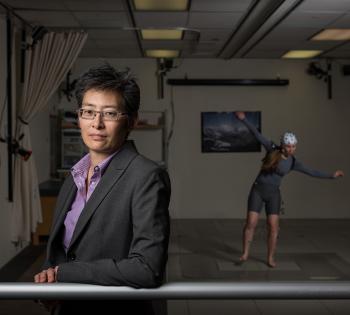
Computational and experimental methods for understanding neuromechanical interactions underlying movement and understanding the neural basis of human balance and mobility. We focus on complex, whole body movements such as walking and balance in healthy aging and neurologically impaired individuals (stroke, Parkinson's disease), and skilled movements involved in dance and sport. We use techniques such as biomechanics, neural recordings of brain activity and muscle activity, robotic interactions, and simulations. We also model the biophysical bases of muscle and proprioceptive sensing to understand their role in movement.
Teaching Interests
Teaching Interests
I am committed to developing and teaching highly interdisciplinary and integrative courses. I have developed and taught several courses aimed at bridging the gap between engineering and biology, such as BMED 8841 Computational Neuromechanics, as well as between engineering and clinical problems such as BMED 8843 Clinical Experience for Engineers and BMED 8813 Computational Neuromechanics. I'm also passionate about teaching about grantwriting and science communication, which has been incorporated into the BME PhD core courses.
Publications
Publications
Media